Showing posts with label racism. Show all posts

Thursday, July 25, 2019

Sojourner Truth, Booker Wright, and The Question of Who Controls the Narratives of Disabled Black People

Image of Sojourner Truth, an African American woman
in a white bonnet and shawl and dark gown, seated in a
chair beneath the image, the words read "I sell the shadow to
support the substance, Sojourner Truth. circa 1870,
By Randall Studio - https://npg.si.edu/object/npg_NPG.79.220,
Public Domain, https://commons.wikimedia.org/w/index.php?curid=77744170
I have been thinking about the conflicting, debated, censored, and sparse information about the life of Sojourner Truth.

I read the arguments in the debate about whether an illiterate disabled woman of color can have agency in what is said and written about her lived experience.

That got me to thinking about Booker Wright.

The story of Booker Wright, like the story of Sojourner Truth, has a central question: whose voice actually dictates the lived experience narratives of oppressed minorities when the very language and media used to tell such stories is completely controlled by the systems that oppress them?

Booker Wright was a Black waiter in a "white's only" restaurant in Greenwood, Mississippi. He was, in fact, the most popular waiter there. He was considered a "good Negro." He knew the hidden curriculum of Jim Crow well and his customers saw him as a "happy Negro."

It was 1965, and a documentary filmmaker for NBC was in Greenwood working on the white man's view of the Civil Rights movement. He heard that Booker Wright sang the menu, Mistral Show fashion, and he thought that an interesting oddity, so he decided to film it. When the camera rolled, the journalist got a surprise. After he was done reciting the menu, Booker realized he had a chance to speak about what life was truly like for him in the South and he did.


 That decision cost him his job, his business, his safety, and his life.

Booker Wright was a restaurant owner. His place was considered a safe space for Black families in segregated Mississippi. After his interview aired, his restaurant was destroyed. Booker Wright was pistol-whipped and hospitalized. Eventually, he was murdered.

His interview is considered the pivotal point of that documentary. It made the documentary a success for journalist Frank DeFelitta, but DeFelitta regretted publishing the interview because of the retaliation and harm Wright suffered as a result. DeFelitta claims he asked Wright whether he was certain he was okay with keeping the entire interview in the documentary. DeFelitta had a sense of what that might cost Wright, but he chose to air it anyway.

Yet, this interview was the only time Booker Wright was able to speak his truth in his own voice to the largest audience that might ever hear it. He thought of the better life he wanted for his children and their children and he did what was right knowing it would probably cost him his life.

Sojourner Truth, like Booker Wright, was trapped in the limitations of the times she lived in, despite "breaking barriers" by suing in court to gain her son's freedom, despite speaking at a women's rights convention before women had the right to vote. Everything she did, even as an emancipated woman, was informed by the limits society placed on her by keeping her enslaved, disabled by violence, illiterate, and limiting what any woman could do without a man's consent or protection.

Sojourner Truth's life story was whitewashed of any mention of sexual assault, despite historical evidence that her daughter Diana may have been the product of a rape by John Dumont. In the 136 years since Sojourner Truth's death, the systemic use of her narrative as a symbol stripped of many brutal realities of who she was have left us with yet another gap in American disability rights history. Sojourner Truth continues to exist as niche black civil rights and feminist icon, stripped of the disabilities that made her a complex, three-dimensional historical figure. To do what she did, when she did it makes the complete image of who she was something of critical historical importance. Sojourner Truth took her moment and spoke truth to power. Her example was there when Booker Wright saw his chance and made his decision to risk all and speak out.

Sojourner Truth was a radical activist. But the question of who controlled the narrative of her life experience as an emancipated activist can be answered by how strong her voice was in written versions of her speeches and the autobiographical book written on her behalf. There is a strong record of her active participation in Marius Robinson’s June 21, 1851 transcription of her speech at the Woman's Rights Convention in Akron, Ohio on May 29, 1851, for The Anti-Slavery Bugle. The 'Ain't I A Woman' version done by Frances Gage appearing in the April 23, 1863 issue of the New York Independent, is considered inaccurate. There is no record of Sojourner Truth's agency or participation in rewriting this version of the speech she gave. There does seem to be evidence in notes that she was an active participant in the drafts of her life story.

Truth's ability to gain a platform to speak her truth came at a cost. The resentment of southern white suffragettes and the demands of abolitionists who realized her story could be weaponized by ensuring the language appealed to illusions of what whites expected blacks to sound like. This was done to drive their cause forward.

Despite all this, Sojourner Truth, like Booker Wright, had her moment to speak her truth. No amount of rewriting and whitewashing has erased that event. It sits indelibly in both Black and Disability justice history as a triumph of the spirit. As does Mr. Wright's decision to speak outside the lexicon of his oppressors. In this era of fear and hatred, remembering the courage of all disabled people means the difference between courage and doom.


References:

Nell Irvin Painter, Sojourner Truth: A Life, A Symbol (Norton, 1996), p. 19, and Margaret Washington, "Sojourner Truth's America" (Illinois, 2009), 51–52

Compare the two versions of Sojourner Truth's speech at The Sojourner Truth Project's page:https://www.thesojournertruthproject.com/compare-the-speeches

PBS Interview about Booker Wright Documentary co-produced by his granddaughter and directed by Raymond De Felitta, son of the journalist who produced they original the original documentary. https://youtu.be/RxwLe7HapIA


Thursday, January 5, 2017

On Race and Hate Crimes Against Disabled Victims

Melissa Stoddard, light brown skinned natural brown haired
biracial autistic holds a mirror and smiles wearing a pink
two-toned sweater and a rainbow clown wig at McIver
Education Center, Greensboro, NC photo credit Herald Tribune
Melissa Stoddard, pictured on the left, is one of the murder victims who I keep writing about because I will always feel that she was ignored in the worst way by the Autism community after her murder. She is, to quote the Herald Tribune, “The Girl Who No One Saved.” A young and vibrant 11-year-old autistic girl, she was slowly starved, tortured, strapped to a board and left in an empty pool in her family’s backyard at all hours until she died.

I will always be furious about the fact that Melissa was happy with her mother and her school in Greensboro, North Carolina, and that it was the very stepmother who abused and murdered her who called Child Protective Services on her intellectually disabled brother, accusing him of molesting Melissa. I believe the acts of Melissa’s father and stepmother witnessed and related by Melissa’s white stepbrothers should have been adjudicated as hate crimes. The Autism community that continues to roar in outrage at the commuting of Dorothy Spourdalakis' sentence for the brutal stabbing murder of her nonspeaking autistic son Alex simply did not care enough to pursue this.

Could this be because she was not white but the perpetrators of her torture and murder were?

The abuse, neglect, and murder of Melissa Stoddard are sadder in that everyone in Florida, regardless of political affiliation or approach to disability, was equally outraged by her torture and murder. Only the Autism community casts Melissa aside, with the exception of listing her name among the countless numbers of disabled people murdered by parents.

Today, I'm reading in the news that there was a violent assault on a disabled white adult male presenting victim named in some news sources as Austin Hilbourn broadcast on Facebook live. The young woman who live broadcasted it and the suspects responsible have been arrested. The victim was taken to the hospital for treatment. The press seems to be spending very little time wondering about the state of mental and physical health of the victim. I have not seen the video of the assault nor read more than the barest details. But here is why I'm bringing this up today. Those arrested were charged with a hate crime. Should they have been?

Well, of course, they should have been charged with a hate crime! Yes, this is a hate crime against a disabled young man done because of his disability and should be adjudicated as such. Yes, it was made worse by the anti-Trump slurs but those slurs were added to justify the crimes committed and are not the hate crime in and of themselves and this is critically important. This is not about Trump. This is violence against disabled people.

Now is where I state emphatically, no, not every African-American teen in America is culpable for this crime. No, African-American youth is no more dangerous, hate-filled, violent or cruel targeting vulnerable victims than white American youth. We hear about horrific crimes of this nature against disabled youth every month. Many crimes go unreported because prosecutors won't pursue them or parents don't press charges against the criminals responsible. Let me digress a minute and give an example of another horrific crime against a disabled teen where the perpetrators also used a current event to draw attention to their act of violence and broadcast their crime on the Internet.


Remember the horrific ice bucket challenge assault on an autistic teen in Ohio? The perpetrators also filmed and broadcasted their horrible assault. The victim's parents insisted on allowing the broadcast to remain on the Internet, and their solution to this crime against their disabled son, evidence of their own ignorance and ableism, was to endanger more autistics instead of punishing the guilty by insisting the criminals perpetrating the assault be given community service to autistic people instead of prison time . Innocent autistic youth were placed at further risk of emotional harm from these individuals. The wrongheaded idea autism parents have that somehow those who visit physical harm on their children should get to know them in order to understand and possibly befriend them upsets me deeply. Our offspring are not hopeless charity cases so desperate for friendship that those who abuse them should be allowed to continue doing so.

The ice bucket challenge assault, like a similar case of months of torture to an autistic teen filmed by two girls who convinced him to go along by claiming they were his girlfriends, should have been adjudicated as a hate crime against a disabled person. But those who perpetrated the crime and filmed it where white, thus the language used for the assault was not assault but "prank gone wrong" and those who committed this crime were not labeled criminals but called bullies who just needed 'autism awareness.' Autistic youth was presented to the public as a pitiable group, to be looked down upon. This is a variety of victim-blaming as this young man's disability was made an excuse for the criminal actions of his attackers.

The demand for hate crime status in the wake of the Alex Spourdalakis murder presents a new set of ethical issues to our community. If the equally gruesome murders and assaults of countless nonwhite disabled victims like Gilberto Powell and Melissa Stoddard prompted no effort or demand for hate crime classification. and therefore were not adjudicated as hate crimes, then the outcry at this point for hate crime status is again, a matter of the racial makeup of the victims and the perpetrators rather than the severity of the crime. We need to define what we as disability rights activists will do when a crime against any disabled victim, white or nonwhite, should be adjudicated as a hate crime but is not. We must be consistent with our standards for calling crimes against disabled victims hate crimes regardless of the race of the victim or the race and position in society of the perpetrators.

Violence against every minority has increased in the aftermath of Trump's election. It is imperative for everyone in the disabled community to seek safety in new, united, ways not sought after before. Everyone caught up in this polarized glorification of hatred will seek to harm those who appear to be the most vulnerable targets.

To the African American perpetrators of this hate crime: hatred is not the way to hold the President-elect or the racist white supremacists' organizations who backed him accountable for anything. What you have done to this innocent young man is that much more heinous because it harms him as an individual and harms the disabled communities and the African American community. This horrific thing that all of you did and broadcast can now be used to justify all the excessive use of force by police against Black communities across our nation. It can be the excuse for Trump to do any manner of things to us, all from your ignorant act of naked hatred perpetrated on an innocent victim. You may wish to harm yourselves, and that is your choice, but you have no right to harm so many others.

In our rush to declare these acts of violence hate crimes, let us ensure that we are shouting with equal vigor for every member of our disabled community.

Remember, do not allow current racial polarization to hijack the case here. This is an act of violence against a disabled person, despite all the libelous attempts to brand it outlandish things like a Black Lives Matter kidnapping. More crimes like this should be tried as hate crimes, regardless of the race of the perpetrators, not only when the perpetrators are a racial minority shouting anti-Trump slurs.

Melissa Stoddard and Gilberto Powell deserve that and more, they deserve our continued remembrance and support. They don't get it. Let's hope that changes.

------------------------------------

Further Reading:
On Melissa Stoddard:
    As an Invisible Autistic Filicide victim:
http://intersecteddisability.blogspot.com/2013/12/autisms-invisible-filicide-victims.html
    Comprehensive story of her life/death with timeline in the Herald Tribune
http://extra.heraldtribune.com/2014/06/15/stoddard/
    Autistic Hoya on Melissa:
http://www.autistichoya.com/2015/01/black-lives-still-matter.html
On the Hate Crime against Austin Hilbourn, a young disabled man in Chicago
     CNN coverage of the assault along with explanation of what constitutes a hate crime
http://www.cnn.com/2017/01/05/us/chicago-facebook-live-beating/
The latest on the Murder of Alex Spourdalakis
     Emily Willingham, Ph.D. On Alex Spourdalakis /why disability is not an excuse for murder
http://www.forbes.com/sites/emilywillingham/2016/12/13/heres-why-you-dont-want-to-view-disability-as-an-excuse-for-murder/#607af248243d
Examples of other Assaults on Disabled Youth By White Peers Who knew them
      On the Ice Bucket Challenge Assault:
http://www.nydailynews.com/news/crime/teens-dumped-bodily-fluids-autistic-boy-fake-ice-bucket-challenge-prosecutor-article-1.1974154
     Autistic teen boy tortured by two white girls who filmed their abuse
http://www.nydailynews.com/news/national/maryland-girls-tortured-autistic-boy-sheriff-office-article-1.1718983
     White high school football players in Idaho charged with sexually assaulting black, disabled teammate with a coat hanger
On the Checkered Career of the Cop who Assaulted Gilberto Powell
Miami-Dade cop Fernando Villa had problems long before his DUI
http://www.miaminewtimes.com/news/miami-dade-cop-fernando-villa-had-problems-long-before-his-dui-6385652


Saturday, October 15, 2016

Oh To Be Young, Black, And Autistic: The Ignored Murder of Charnice Milton

Image of Charnice Milton, a young African American woman
in braids pulled back neatly with a white tie, a gold loop earring,
wire-rimmed glasses and a white blouse. She is smiling. credit
Black Christian News.
It's been well over a year, and I've blasted social media about this twice, but no autism organization has bothered to even mention it. So I'm going to write once more about the murder of Charnice Milton because Charnice Milton was young, Black, talented, and Autistic.

Charnice was the victim of a drive-by shooting in the neighborhood she dedicated herself to getting voices heard about. She was used as a human shield in a violent exchange that had nothing to do with her. Southeast D.C. still mourns her. The police are asking the pubic's help in finding her murderer.

Her parents discussed her diagnosis, which at that time was labeled Aspergers, and how no one ever thought she'd complete school, much less end up with a masters degree in journalism. Like some African American parents, they spent the next months vacillating between the truth of admitting she was autistic and saying she "had Asperger's like symptoms" when the love for her work and for her by her peers and community overflowed such that her murder became the subject of articles in The Washington Post and The New Yorker.  They rethought their initial admissions and made efforts to mute her autism from the story of her life rather than celebrate the brilliance of her short career as a disabled journalist. But their initial admissions are there in interviews for local television stations.

Meanwhile, all autism organizations remained silent on her murder. There were neither statements of loss nor demands for justice. No hashtags flooded Twitter. The first anniversary of her murder was on May 27th. I was in the hospital and could not attend her vigil. To my knowledge, no representative of any autistic organization did either.

I used to write one of these blog posts each time a Black autistic adult or child was murdered simply to force attention on these events and make the deaths of autistic people of color matter as much as white autistic children. The hypocrisy of being an autism organization and ignoring the murders of Black autistic people but claiming to speak for autistic people of color is something I've hammered on for 5 years.

I shouldn't have to .

Remember Charnice Milton. Make her matter. Her parents, with their intentions of wanting her remembered for her journalism and not her neurodivergence view her success as being in spite of her neurology. They are not grasping how the neurology that disabled her also shaped her drive and her detailed approach  to becoming essentially  an embedded journalist in the most dangerous community in Washington D.C. They are doing her a great disservice by their indecisive attitude towards including her neurology as part of what made her a meticulous and excellent journalist.

But her autism community is doing worse. Because they are acting as if she is not a part of us, as if she doesn't exist at all, and her life and death are of less import than a white autistic person.

When every autistic life and death has equal merit, my need to write these heartbreaking posts will end. Until then, #JusticeforCharniceMilton, Young, Black, Talented, and Autistic. You were appreciated and I hope this small effort will ensure you are not forgotten by the disability rights community.

==============================

References:

The Death of a Young Black Journalist

The Washington Post Local:
https://www.washingtonpost.com/local/public-safety/a-year-after-the-shooting-of-charnice-milton-police-plead-for-help-finding-her-killer/2016/05/26/ec2c09aa-2364-11e6-9e7f-57890b612299_story.html

The New Yorker:
http://www.newyorker.com/news/news-desk/death-of-a-young-black-journalist

NBC Washington:
http://www.nbcwashington.com/news/local/Charnice-Milton-Young-Local-Reporter-Killed-in-Southeast-DC-305382571.html

Monday, October 19, 2015

Random Thoughts at The Intersection of Race, White Privilege, and Disability Rights Advocacy


Black letters on a white field read "No one is asking you
to apologize for being privileged; people want you to
stop using your privilege in ways that require an apology."
Ilana Alazzeh
I've spent the weekend thinking about Ted Landsmark, Danuta Danielsson, Edward Crawford, the miseducation of KKK children, the dominant and at times toxic culture in disability rights activism, and what happens when marginalized people intersect with white privilege. Occasionally I think in pictures. So let me share the people I'm discussing in the way they came to mind as their lives intersected with mine.

In 1976, when I was 15 years old, Stanley Forman took a photograph during the fight to desegregate Boston schools that won a Pulitzer Prize the following year. That day Ted Landsmark became the victim of white protesters like teenager Joseph Rakes, who tried to assault the civil rights attorney with a flagpole bearing the American flag.
Pulitzer Prize winning photo "The Soiling of Old Glory" ©Stanley Forman
Mr. Landsmark later assured investigators that Rakes was not trying to spear him but was in fact swinging the flagpole in the photograph from side to side trying to hit him with it. This simple statement on Mr. Landsmark's part may have saved Mr. Rakes from paying the price for his hatred his entire adult life. Anti-bussing protesters beat Mr. Landsmark severely that day. He was fortunate to have escaped permanent injury.  Rakes was arrested for assault with a deadly weapon. It may or may not surprise readers to know his jail sentence was suspended.

The snapshot of the violent Boston anti-bussing protests punctuated by incidents like the assault on Ted Landsmark  emphasizes that poor or working class white people become conciously aware of their privilege only when they view it as being under threat, at which point they lash out to preserve it.

The majority of violent white anti-bussing protesters were considered "good hard working people of faith" who became aware that their children had the privilege of attending segregated public schools and fought violently to retain said privilege only when they were ordered to adhere to federal law requiring they include Black students in their schools. This historical event counters the common misconception that white privilege is a false construct because a white person who is working class or poor has no inherent privilege in society.

These events took place in Boston over 20 years after Brown v Board of Ed of Topeka, Kansas, in Massachusetts, not in Alabama or Mississippi. This should also emphasize that racism is not limited to one geographic area, disparities and crises driven by the racial divide are in fact equal; just expressed differently in the other areas of the country.

In April of 1985, when I was in and out of hospitals with my asthmatic 2 year old daughter wondering if a move to Europe from Turkey was the best thing for my little one, Danuta Danielsson witnessed a demonstration in Växjö, Sweden and, unable to control her outrage at seeing the nazi-skinhead marchers supporting the Nordic Reich Party she rushed out, hitting one with her handbag. She was 38 at the time. Ms. Danielsson was of Polish Jewish origin, and her mother had been placed in a concentration camp during World War II. 

Woman hits Neo-Nazi with handbag, ©Hans Runesson
Ms. Danielsson was not arrested or charged for her actions. Attempts to install a sculptural depiction of this photograph were rejected by local Swedish politicians of the Centre Party for fear it might promote violence.

I and most people at the time empathized with Danuta Danielsson and grasped why she would strike out at someone young and ignorant enough to brazenly march in support of an anti semitic political party despite knowing the barbarity and scope of the holocaust. No charges were filed against her.  She actively avoided the press or any notoriety for this act or the photograph that immortalized it.

Can we all accept that this act did not deserve to be labeled an act of violence?
  1. Ms. Danielsson appeared to react spontaneously upon being triggered by those marching.
  2. Doesn't the circumstance of her being a traumatized member of a marginalized minority that was the target of genocide by those who established the philosophy being supported by the target of her attack, justify her behavior?
  3.  Should survivors of atrocities and their families be made helpless witnesses to the power of  those born with white privilege who were never targets of mass genocide, using that privilege to legally impose and promote white supremacist political views that justified the mass murder of millions of innocent people? 
Whatever the intent of this party and those in it, they are cogs in a greater wheel that abuses white privilege to drive discrimination by perpetuation of beliefs we know are untrue. These negative constructs are constantly retaught to white children, and they grow up, regardless of anything else that might make them divergent from their peers, with this persistent and ingrained parasite of hate that invades them and propagates such that it is passed on to their children and grandchildren effortlessly.

“White power structures often persist independently of the good or bad intentions of White individuals.”  
 - Dr. Katherine Tyler
Last August, 13 years after coming back home and witnessing an increasing polarization of the country along racial lines, I was still reeling from the increasing shootings of Black people and trying to follow the nationwide protests online when photographer Robert Cohen's picture of 25 year old Edward Crawford, the "flag and chips man" of Ferguson, Missouri went viral on social media. Mr. Crawford was caught in the middle of lobbing a tear gas can shot at the children of protesters back at police while not disturbing his bag of chips. Initially this photo was misrepresented by some media outlets as a Black protestor throwing a molotov cocktail.
Edward Crawford, 'whose bag of chips read "the flavor of America's heartland"
throwing a flaming tear gas canister duringFerguson protests @Robert Cohen

I always wonder what white people who are clueless of the impact their own white privilege has on their lives, thought when they first saw this photograph. Because I know that it was probably not what I was thinking. When all these events were unfolding I wondered how those of us trying to fight hate enabled by the abuse of white privilege could overcome the miseducation of white people who refuse to acknowledge their own privilege. How could we explain topics like structural racism to people who don't acknowledge their own complicity in this abusive cycle? How can we show academics and graduate students in fields like disability studies who don't really care how the misuse of white privilege influences their work, the way they view and present facts can cause harm?

Ignoring this bias infuses content with constructs that perpetuate and preserve the prejudices that impose the greatest disparities in how disabled POC in general and disabled Black people in particular receive a free and appropriate education, therapies, state supports, and critical health care. When white privilege is misused to justify deliberately ignoring how content promotes racism,  disabled Black children are misrepresented, research is driven and founded on stereotypes, and disabled Black children are denied the cognitive, physical, and emotional fitness needed to survive and self advocate in society and this continues mistaken beliefs like, for example, the fallacy that Black autistics express autism more severely and have greater challenges because of their race. In fact how autism presents has a great deal less to do with race and a great deal more to do with delays in diagnosing autism and the resulting disparities in all the services and accommodations needed to support Autistic children of color in general and Autistic Black children in particular.

Worse, this lack of willingness to understand terms that don't mean what most presume they mean attaches a stigma to them that distances white people from trying to change. Wrong headed ideas based on modern stereotypes, like the concept that being a political liberal, dating outside one's race, having Black friends and colleagues, or being highly educated exempts a white activist from thoughtlessly perpetuating structural discrimination is dangerously flawed. This attitudinal erasure keeps regenerating a mentality that views Black people as less than rather than equal, a collective 'problem' to be dealt with and Black disabled people as a 'greater societal burden' than white disabled people.

 Child of Klansman meets Black State Trooper
 photo by Todd Robertson, credit Southern Poverty Law Center
I have hit a wall of insensitivity and erasure on how to explain this to my own colleagues. I can't constantly be in the position of appealing to activists and academicians who are supposed to care about my son and his peers as much as they care about white disabled people. I felt it was possible to present things to reasonable people and have them first be willing to look in the mirror and  then analyze where they may need to make changes in how they present disabled people of color in essays on social media. That requires that people respect Black disabled activists first, respect marginalized activists' topic expertise, and have a willingness to accept the world as it truly is not only for them but for disabled people of diverse races and cultures about whom they may be ignorant. I did not think that was such an impossible thing to ask.

It turns out it is.

Like everything in the conversation of structural racism, telling authors and bloggers that their misuse of white privilege is fostering presumptions that are negatively impacting their content is apparently highly inflammatory.  The term 'white privilege' makes everyone squirm. They don't want to be labeled someone whose white privilege has gone wrong in their academic work or online content generation. So they do what many do when confronted by someone with an inconvenient truth online: they mass their followers and begin a flame war.  All manner of gaslighting and other unpleasantness will ensue. But the actual concern, that something in any given content may perpetuate structural racism or denigrate Black disabled people ends up derailed and dismissed.

This is my fault too, because I let other white colleagues who truly want increased diversity in the disability rights community convince me that if I tried to educate, activists would listen and this was simply not true.

Understanding that I have wasted four years of my life thinking I could explain and colleagues would read and listen is tough. But it is also good to divest myself of this fruitless pursuit without bitterness and with the realization that it is not the job of the marginalized person to constantly teach to the privileged group. It is time to focus on things that might just truly make transformative change for my own people, my son, and his peers.

The presumption that writing would give me a voice that might be heard was not completely accurate. Blogging gives me a voice. But those who need to change do not heed it and that means this path to trying to change minds is failing.The disadvantage of heeding those who speak out about not inadvertently perpetuating racism in disability rights activism is that no one can gain anything but a clear conscience from listening to such voices. There is no academic, fiscal, or professional profit in presenting information in a manner which isn't offensive. It is just the right thing to do.

A friend and colleague who does great things offline told me he could not do what I do online. He said no matter what I write to try and reach people, they will resent, react, troll, and insult me. I am beginning to agree with him and am exploring ways reinvest the limited time I have for activism accordingly.

 Online blogging will probably continue, but with no expectation or hope of impact, and with no presumption that persons with white privilege who are academicians or disability rights activists who need to change will heed or respect voices like mine. It will simply be an exercise in expressing my thoughts and leaving them for my son, in the hope that he may someday understand the words I've written. He should know that his mother tried to do something to make the world a safer and more just place for him, even if she failed.

Of all the labels I carry, the one I am proudest of, my race, is going to continue to be the most marginalized. No outward displays of superficial willingness at equality or diversity will change the bias and disparities inherent in the disability rights conversation until those who dominate it are willing to see how the abuse of white privilege impacts their work and act to correct harmful things perpetuated by this without the presumption that white privilege or even racist actions are stigmatizing permanent labels meant to ruin their reputations. The lives of Black disabled people hang in the balance of understanding that the road to healing the racial divide in our community is to first accept when things like white privilege abuse driven structural racism are identified, even when what is exposed is internal.

Peace


Resources and References

About Artist Ilanah Alazzeh
https://about.me/ilanatree

Brown v Board of Education
http://www.ourdocuments.gov/doc.php?flash=true&doc=87

"The Soiling of Old Glory"
https://en.wikipedia.org/wiki/The_Soiling_of_Old_Glory

The Photography of Hans Runesson
www.hansrunesson.se/

A Woman Hitting a Neo-Nazi With Her Handbag
https://en.wikipedia.org/wiki/A_Woman_Hitting_a_Neo-Nazi_With_Her_Handbag

 About The Iconic Ferguson, Missouri Protest Photo
http://www.fastcompany.com/3034842/innovation-agents/3-things-that-turned-this-photograph-into-a-ferguson-icon

About Dr. Katherine Tyler
http://socialsciences.exeter.ac.uk/sociology/staff/tyler/
http://socialsciences.exeter.ac.uk/sociology/staff/tyler/publications/

References: Towards a Bibliography of Critical Whiteness Studies
http://nathanrtodd.netfirms.com/documents/Spanierman_Todd_Neville(2006)Whiteness_Bib.pdf

A moment of hate free interaction: Klan baby meets Black State Trooper
http://www.poynter.org/news/mediawire/199985/how-kkk-rally-image-found-new-life-20-years-after-it-was-published/

Thursday, December 4, 2014

I Can't Breathe


There is no greater tyranny than that which is perpetrated under the shield of the law and in the name of justice.” 
― Montesquieu, The Spirit of the Laws


The Civil Rights Act of 1964 @National Archives Documents
I can't get that quote out of my head. It is clanging in there like a brick dropped in a steel drum. Here I am, marinating in the pain of human rights lost and the clear and present danger to people of my race in the United States, the country that tries to dictate right and wrong to the world. This pain is deep, and old. Nightmares of the harms done to me and mine haunted my dreams last night. The illusion of justice we convinced ourselves we had was a veneer that has been dissolved away.  Events are proceeding as if there is no need to hide the fact we've lived with for over 100 years: justice is not for those Americans who are Black and poor. The right to be safely taken into custody and tried by a jury of one's peers if one is suspected of committing a crime is not for people of color. It is as if institutionalized shooting is the new way of lynching. Being shot to death can happen to seven year old Aiyana Stanley Jones, sleeping on a couch in what passed for her home.  It can be done out of malice to Ronald Madison, 40 and autistic. Anyone can be the next potential victim.  It could happen to Oprah Winfrey as she learned when her fame and $2.9 billion net worth failed to keep her from being treated like the rest of us when entering a store to buy a purse. You can't buy your way out of this legacy with money, or education, athleticism, or winning the office of the President of the United States.  Each day for the rest of our lives, we will be reminded that we are Black, and if we don't agree that Black is less,  if we don't look away when the dominant culture dictates that the Black body be the beast of burden of society then we will be made to stand by helplessly while our people are shot. The murders are here to tear at our hearts and remind us that we have no voice in this society. July 2, 1964 makes no difference today. The Civil Rights Act is so much paper and photo op. This effort, for which so many continue to die, is failing. All men are created equal as long as those men are not Black and poor.

What do I say to my boy today? We are already harassed when we try and take walks and try to go out and see our world together. A gray haired Black woman walking unsteadily down a sidewalk with a large, hispanic looking male leaning on her for support. Will they shoot us today? Will he look threatening? What if he's having a meltdown? What do I tell him if they hurt him? That 'the arc of the moral universe is long, but it bends towards justice?' Because I have been waiting for it to bend in that direction since 1965. It just is not bending.

The Scottsboro Boys, with attorney Samuel Leibowitz,
under guard by the state militia, 1932. Image is of 9 Black teens in
 a cage with two white Alabama militia men and their attorney,
 who was white. 
I must again change how we interact with the world. Because our world differs from the world of the autism families who continue to dominate the autism conversation. Our world  is now less safe.

What the grand jury ruling in the Eric Garner murder means is body cameras on police will not change an outcome that is only a surprise to people who aren't black or brown. A camera on a body is only as good as the person wearing it. It can easily be shut off, or disregarded as evidence in grand jury hearings and trials. There is no route to accountability if accountability is simply a modern rerun of the way things were done in Alabama, when the Scottsboro boys were rounded up and tried for a crime that never happened because white boys were caught hoboing on a train, and wanted to get out of trouble. That happened 80 years ago. Has anything in the justice system changed? Not really. Even seeing injustice with our own eyes is not enough. Our eyes, the gaslighting voice of authority says, deceive us. Only things we can't comprehend matter. The weight of our words as witnesses are light. We are dismissed. Only power and privilege matter. So what do I do now? Where do I go from here? It isn't just a question I'm asking myself as an activist who has hit the insurmountable wall of institutionalized racism this entire year. It is a question I am asking as the mother of a nonspeaking autistic son in an American horror story of police in public schools, the resurgence of hate groups and those groups being given national media coverage to spew hate on us. People with power who see my son, with his budding mustache and older look, larger than his peers and neurdivergent, as a threat where he is not one. They see him and are afraid. The worst atrocities in our lifetime have been the byproducts of fear. Unnecessary fear based on ignorance, the hate that fear generates, and the devastating consequences to our people. Atrocities, forgiven under the shield of the law and in the name of justice.

I am rethinking my entire way of living and wondering, terrified,  what I can do to keep him from being another Neli Latson, in solitary confinement for the new crime of wanting to end his life because of the horrible circumstances that brought him from going to the library to the iron grip of a system that doesn't care that he has no understanding of what he did wrong. The law says if he does not understand what he did, he is not fit to be tried. But if you find yourself in Neli's situation, you'd better not be Black in Virginia.

See when I say justice for Michael Brown, what I am saying is that a man should not be shot repeatedly for jaywalking, in the same country where, as a person said on social media, a white male with bright orange hair walks into a theatre, throws tear gas and fires an assault rife, kills 12, wounds 70 victims and is taken alive. When I say justice for Eric Garner, I mean a man who died before our eyes crushed in an illegal chokehold for selling untaxed cigarettes should not have died in a country where Cliven Bundy, a rancher who owes more than $1 million to the federal government for late grazing and trespassing fees, which he has been accruing since the 1990's and refusing to pay, can simply not pay, and armed white people can plant themselves on federal land and scream "State's rights!". Cliven Bundy, the bigot, who later said awful things about my people, is free, his cattle grazing on federal land, and will never be arrested for anything.

I am not anti police and will challenge anyone to tries to slap that label on me. Having been fortunate enough to know outstanding law enforcement officers, seeing those who abuse that power makes me angry. This abuse of power denigrates all police officers who do their jobs and perform in an outstanding manner each day of their careers. Each time, in an attempt to protect police officers in general, someone abusing power is allowed to get away with it a huge canyon divide opens between law enforcement and our community. No amount of talk can repair what doing the right thing can.

There is a hashtag sign people are carrying in the streets, an echo of Eric Garner's dying words. It is a summary of my trying to collect myself, my disgust at organizations that should have done more before now and did not, the rampant racism within disability rights organizations that has me reeling this year,  my own attempts to cease hugging my neurodivergent son and husband in shock wondering when this nightmare will end.


The hashtag sign says simply I can't breathe.

Sunday, November 16, 2014

Making Neli Latson Matter: The Invisible Intersected Black Members of The Autism Community

I have been haunted by the case of Reginald "Neli" Latson, a victim of racism and ableism for four
Neli Latson in 2010
years.  His case has taken a grisly turn. He attempted to take his own life, barricading himself in a room of the group halfway house where his abuse had become intolerable. He is now locked in what is in essence solitary confinement (he was taken out of straight solitary and is now in isolation with suicide monitoring) in a Virginia prison.

Solitary Confinement is torture.

According to the definition of torture under 18 U.S.C. §§ 2340–2340A :

1) “torture” means an act committed by a person acting under the color of law specifically intended to inflict severe physical or mental pain or suffering (other than pain or suffering incidental to lawful sanctions) upon another person within his custody or physical control;
(2) “severe mental pain or suffering” means the prolonged mental harm caused by or resulting from
     (A) the intentional infliction or threatened infliction of severe physical pain or suffering;
     (B) the administration or application, or threatened administration or application, of mind-altering substances or other procedures calculated to disrupt profoundly the senses or the personality;
    (C) the threat of imminent death; or
    (D) the threat that another person will imminently be subjected to death, severe physical pain or suffering, or the administration or application of mind-altering substances or other procedures calculated to disrupt profoundly the senses or personality;

Any research into the effects of solitary confinement on any human being will quickly make it clear that solitary confinement, regardless of the reason it is being done, is torture.

If you are anyone who is Black in America, you know the sequence of events that results in arrests for Black males. There is no rise in social class, no degree of education, no party affiliation that can save your sons, spouses, fathers, friends, from this. It is part of the racism that we live with. It is the fear we carry. You cannot train a human being to not abuse power. You cannot foresee the hate in a person's heart. You cannot tell if a man is a bigot if you are white. Your race is not the one such a person holds in enmity.  Not three days ago I was asked to describe disparities in the way healthcare was delivered to my son when I was with him. When I described an incident, the interviewer said "are you sure it was racism?" Probably the worst thing you can ask someone like me, who lives with racism everyday, is if I am sure it was racism. In the past, when I was a younger and more patient person, I would insist that people who asked me that question simply come to a mall with me and lag behind me as I walked through stores and watch my interactions and what was done when I entered shops. The shame they felt as they watched security guards and staff follow me from aisle to aisle to insure I wasn't stealing anything was enough. Yes I am sure it was racism.

Reginald Neli Latson
Tell me how do I explain to such a person that the problem with Neli Latson is not simply "autism causing him to act out"?  How will they understand that there is a world in which the color of one's skin is enough to get an arrest record whether one commits a crime or not? How to hammer home that all of this combined with a bigot who called 911 as a "concerned citizen" saw a black man in a hoodie waiting for the public library to open and decided to lie and say they saw a gun doomed Neli before he ever encountered that school resource officer? Because I've tried. And they just can't leave the world they live in long enough to understand this one.

Their world is comfortable and safe. They don't have to do anything but mumble words of sympathy because they are so confident it won't happen to their autistic child. Why should it? They are sure their social position, income, and race keeps their children safe. They forget something very important. Neli Latson would not have come to this horrible pass had he not also been autistic. This disaster is the intersection of autism, ableism and racism colliding with the school to prison pipeline. See everyone who is poor in Black America prepares their son for that moment. They teach them the social cues and red flags. They tell them to have a way to make that phone call and an understanding that they will be harassed by police at some point.  But autism parents are told they need to teach compliance and concrete ideas about police to their autistic children. It gives autism parents a false sense of security about their teens encountering police.

 Every autism parent who  secretly thinks a police training course,  safety movie,  who they know,  their race or wealth will keep this from happening to their child can think again. Ableism is as obvious in this case as racism. Neli was a popular student,  well known in the area and that is why he was able to walk to the library alone without prior incident. But the person who called 911 that day was tired of seeing the Black autistic kid waiting for the library to open. Black and neurodivergent was just too different for tolerance. The fact that to this day, the caller's identity is hidden is very damning.

Neli did not understand the intersection of racism and abuse of power. He understood the rules of police engagement and was taught that everyone had rights under the law. That of course does not leave room for how to react when racism places a black body in jeopardy. No one told him that Black males are routinely harassed by police and if the officer doesn't like the look of them, they will arrest them on any excuse. Neli wasn't taught what to do if the police should continue to escalate or try to incite an act that might result in an arrest. He was not told to remain passive even if insulted, beaten or arrested even if he had done nothing wrong. He reacted as he did in high school wrestling matches when set upon. This reaction destroyed his life.

For four years, I have felt like I've been in a nightmare where I scream and people see my mouth move but no sound is heard. No matter what I did or do, no one sees or hears Neli.  Neli's former attorney was ignorant of autism so the defense was a disaster as it in fact supported the case that autism makes Neli dangerous.  The Washington Post at one point flipped its initial  and recent balanced coverage of the case to support this incorrect perspective of the "dark side of autism" complete with parent interviews.  The presentation of the unfortunate defense case opened the way to a 25 year sentence. Autism organizations used Neli's case as a cautionary tale of the evils of not using  early intervention where "therapy" means compliance training through ABA and then promoted their own first responder training materials.

I have been unable to make all of this injustice felt to organizations, advocates, and activists. They don't get that arrests for no reason, stop and frisks, and any number of incidents are regular issues that those who are Black and poor learn to prepare for, but when one is Black and neurodivergent, may not be able to process, even with parental help. Add to this something else well known in services circles and you have Neli's recipe for disaster. Parents are told the dirty little secret to getting a rapid placement for your autistic adult child who has aged out of the education support system in times when no available placements exist is to document proof that the young adult is a danger to himself and others. "Call the police", they tell parents. Have documented proof they need immediate placement and social services will have to step in.

I have been unable to stem that tide. Parents do this never thinking that in their rush to get this large autistic adult off their hands they may be setting that person up for a lifetime of suffering. In the end that is what happened to Neli. He ended up having a prior incident, as happens with many young autistic males growing up, where police were called and should not have been called. Then the catastrophic encounter with a school resource officer when all he wanted was to go to the library. He was Black. He was wearing a hoodie. He did not know the script for reacting to racism in an authority figure who could incarcerate him. He does not know what is happening to him now.

As I have written before, great demands are placed on those of us who are Black activists for content, supporting presentations, speaking out about racism, intersectionality and ethnicity by organizations and groups, but when our disabled loved ones are in desperate need of help they are silent and absent. Neli needs help now. If I have been a good ally to cross disability causes and other marginalized groups I expect that when one of us is the victim of injustice allies will step up for them. If they don't that tells me that they won't be there for my family either. When we activists of color step away from organizations, communities and groups where others feel we are underrepresented, those stakeholders should look in the mirror. Neli Latson could be my son or anyone's son. Not helping him is akin to turning your back on all Black disabled children, adults, and their families.

The Autistic Self Advocacy Network decided to step up and try to help Neli. You can read about their efforts here. They are one of the very few autism or disability rights organizations that seems to give a damn. So many disability rights advocacy organizations are filled with attorneys who won't touch this. Shame on them! They have no right to call themselves advocates of the disabled if they turn their noses up at defending Neli. It makes them part of the systemic erasure of intersected Black disabled males who are victims of a criminal justice industrial complex they cannot avoid or be free from without help. What do these people do? I see them hobnobbing with congressmen and senators. In the meantime God knows how many Neli's are deteriorating in prisons across this country. Isn't it time disability rights advocacy organizations and advocates join with organizations like Solitary Watch and add  ending solitary confinement, humane conditions and therapeutic supports for neurodivergent prisoners to their diversity related national agendas? Shouldn't their attorneys be fighting for this? No organization can insist they represent us or our children unless they address this urgently. 

Anyone who isn't making an effort to help Neli does not speak for of Black disabled people or their families. That is my position. Wonder why I don't respect your organization? That is why.  When you make Neli and so many others like him matter, you'll matter to me. Otherwise, lose my email address and don't put your hand out for my money every December and my voice, support, and content year round.

#FreeNeli


Thursday, August 7, 2014

On Disparity in Education: The Risks and Bravery of Being First

The school year is about to begin.

Being one of the first or the only students with any discernible divergence in any characteristic is dangerous, difficult, and involves tremendous courage. Over 50 years ago, at the beginning of a school year,  the Little Rock Nine walked with angry white mobs behind them into their local high school to exercise their right to a public education with their white peers. Initially, the Arkansas national guard blocked their entrance by order of the Arkansas governor. Eventually, President Eisenhower ordered  my stepfather's unit, the 101 airborne division, excluding my stepfather and all black soldiers, to escort the students to and from the high school. Time Magazine's 2007 Legacy of Little Rock article recap of the more than half century that has passed since these events reminds us that sadly, most of our schools are still bereft of equality and still segregated along racial and socioeconomic lines. Most schools today are also not truly inclusive of disabled students, particularly those who have apparent differences,  multiple challenges, or whose neurodivergence is clear and cannot be masked.

 The thing about relating historic events is that documenting them doesn't always impart the impact on those taking part in them.

Image description: Elizabeth Eckford. a tall black teenaged girl in a white and plaid dress, sunglasses, and short curly hair, tries ignoring the insults of Hazel Bryan (2nd from the R), and others in a crowd of taunting whites bullying her as she tries to reach Little Rock Central High School, September 4, 1957.

We frequently discuss bullying in schools, and how things must be done to stop it. Disparities in education amplify the likelihood of abuse of all minority pupils in  life threatening ways on a daily basis. When a student steps up and insists on exercising their right to a free and appropriate education, and that student's parents make the decision to support their son or daughter, an entire series of events is set into motion. These events that set the stage for disaster in the aftermath of victory evolve from the resentment of radical change by those who feel they benefit in some way from the status quo. Being new, different, first, has consequences. What happens if, unlike the Little Rock Nine, a student who is divergent is unable to inform parents when staff and other students are targeting them because they are different? What are their options? For those of us who were students of color in the 60s and 70s integrating all white schools, administrators, teachers, and staff were many times not our friends and some were our abusers. If you were verbally abused, bullied, beaten, or worse, some staff looked the other way. This reality of constant sustained maltreatment is a fact of public school life that parents might understand intellectually but are not able to grasp viscerally. Their divergent preteen or teen  must walk into that war zone each day alone.

In the fall of 2012 at Hillsborough County Florida's Rodgers Middle School, special needs student Jennifer Caballero walked out of her gym class. We will never know why. Jennifer's body was found 6 hours later by divers in a pond. 
Image is a photo of Jennifer Caballero
An 11 yr old Hispanic girl with dark hair
worn down with bangs. She is looking up.
Her mouth is open in what looks to be the
beginning of a smile.


The presumption made was that Jennifer's disability influenced her behavior and she simply wandered off. But every competent professional I have questioned on the topic of student wandering, elopement, truancy, and absenteeism stated that if a student wishes to leave an environment there is something wrong with the environment not the student. In fact, a week later, a different Hillsborough school district teacher failed to report that another special needs student in another middle school was missing from her classroom. If these students were not neurodivergent, many things would come into question. Are these students being bullied or ignored in their schools? What is happening to drive this low tolerance of the school environment? I know among those of us who were many times forced to integrate all white schools, the abusive environment was too much, and because those in a position of power had no interest or regard for the abused pupils, students would simply cease attending. No one would assume that if a typical student walked out the student was the sole problem. Only in school districts where extreme poverty exists, the school has a disproportionately high nonwhite population, or the student is in special education is this somehow an acceptable answer.  The Hillsborough County school district has the disturbing record of having three students, all minorities, all neurodivergent, die while in their care. Cases like these end up settled in lawsuits and forgotten. Meanwhile those critical factors in both the micro and macro cosmic milieu of the student preceding the catastrophic event are not addressed or changed. 


 As a student who survived things happening sometimes right under the noses of well meaning classmates and good teachers, I wonder how I can emphasize the depth of the crisis here. It isn't just a crisis of one district school system. It is a crisis of attitudinal ableism that permeates the present education environmental infrastructure such that when harm comes to a student, the student, who is the victim, is blamed. It was not the fault of Elizabeth Eckford and the other eight black students who tried to attend high school that each day of their school year was a hell of angry white mobs hurling insults and threatening harm; nor that this maltreatment continued inside the school as well. It was the fault of the setting they were forced into and those who administrated it. Leadership sets the tone for how any student is treated in school. What you see in the picture of Elizabeth above is akin to what is faced by many disabled students in general and neurodivergent students in particular throughout their academic lives. The more apparent the difference the higher the rate of daily maltreatment. The "cover your public entity's behind" approach to school administration does nothing to insure the welfare of students at high risk for victimization. When someone is noticeably behaviorally, intellectually, or physically different, isolating them from their peers will not help reduce bullying and maltreatment. Segregating them within the greater general population of students doesn't help either. I want to end this cycle of secret harm that happens even when our children have made some headway towards inclusion by in some way shape or form entering their neighborhood schools as Henry Frost has. We need to understand that the Henrys of the world are paying a high price in trade for their insistence on justice and what is right. We need to step our support of them up a notch as a community. Doing so might be one of many ways to help prevent the deaths of students like Jennifer, while protecting the mental health and welfare of students like Henry and my own son Mustafa.

This is an example of an idea simmering in my head. A kind of roadmap maybe. When a new divergent student transitions into a neighborhood school there should be a transitioning plan in place for all parties involved (beyond the IEP of the student) whose aim is the safe absorption of the student into the academic and social life of the school. This could be done if stakeholders:

1. Acknowledge that both the first students to enter full inclusion and the fewest of any minority group will be gaped at, maltreated, and jeered at behind the backs of staff and administrators. So it falls upon the faculty, administration and staff to create bridges to introduce these students to the student body at large and ask for volunteer peer mentors to actively take on goodwill ambassador roles for students transitioning into fully inclusive environments.

2. Arrange mandatory team teaching and inclusive education training for staff and teachers that includes understanding and overcoming ableism, spotting red flags indicating bullying or maltreatment of divergent students, and a toolkit for transitioning to an inclusive classroom teaching protocol that mitigates bullying and fosters inclusion by example.

3. Create anonymous, safe, procedural protocols for reporting incidences of abuse against special needs students that protect faculty, staff, and students from retaliatory action from superiors or aggressive peer groups. 

4.  Create a route for either virtual or onsite observation of schools and classrooms where true full inclusion is working and auditing schools where it is not. Compare what is being done right with what is going wrong and include all shareholders as equal members in making inclusive schools safe academic environments for all.

 I cannot ask Henry Frost how his year in his neighborhood school went. It is a personal thing that he
Image of Henry Miles Frost and his service dog, Denzel,
Henry is holding two signs the large one in white, reads
"The Civil Rights Act of 1964 granted equal rights to all
people." "I am a person". "I want these rights".
may not be ready to discuss. Ever.  I can only guess. I can only guess what may have been on Jennifer Caballero's mind when she decided to leave the gym on the last day of her life. I can only imagine what was going on in Elizabeth Eckford's mind when the picture posted above was taken on September of 1957. Having been in their positions, I can only salute these brave souls, and pledge solidarity from a fellow survivor. And to brave Jennifer Caballero, rest in peace. We will remember you. Change is going to come. 


Links
http://content.time.com/time/magazine/article/0,9171,1663841,00.html 
http://www.huffingtonpost.com/2012/10/23/body-of-missing-11-year-o_n_2007099.html
http://www.tampabay.com/news/education/teachers/hillsborough-teacher-fired-for-letting-special-needs-student-wander-away/2164074
http://stateimpact.npr.org/florida/2012/10/10/social-media-helps-student-with-autism-find-his-voice/


Friday, March 14, 2014

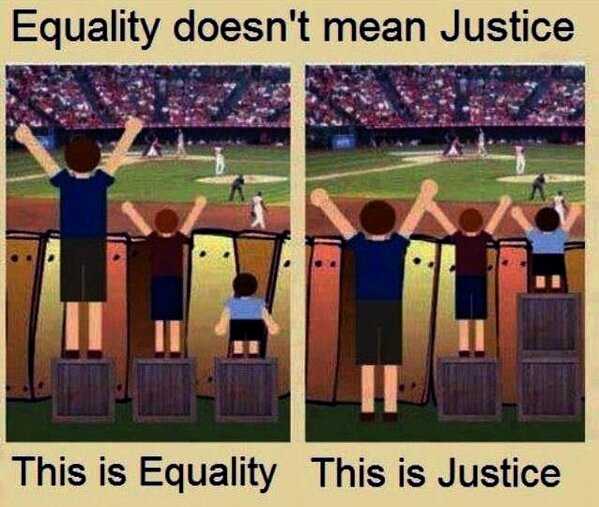
On Disparity in Education: Equality is Not Justice

There was a meme making the rounds of all the social networking communities a while ago. The meme was entitled "Equality Doesn't Mean Justice". This is a derivation of a meme by professor Craig Froehle. Let me post it here to save time:
Image is a two frame caricature the first is of a tall man a man middle height and a very short man all standing on boxes of equal size trying to look over a fence at a baseball game. The tall man and shorter man are able to see but the smallest man is not. The caption below the first frame reads "This is equality". In the next frame the shortest man is now able to see the game because he is standing on two boxes, and the shorter man is standing on one. The tall man needs no box and is still able to see the game. The caption under this frame reads "This is justice". 

It is very difficult to explain this distinction to any professional who has no understanding that my son's race, gender, perceived socioeconomic status and his degree of disability combine to leave him vulnerable to the same negative stereotypical  biases that have caused harm to him in the past. What is seen as equal is presumed to be just. My son needs three boxes to reach the justice of a free and appropriate education. He cannot be presumed to be treated fairly because his treatment is equal to another child of equal pathology who has no intersectional factors increasing risk of unjust placement and maltreatment in the classroom.

Appropriate education was meant to achieve equality with average students in public schools. But this approach is rarely just, particularly for students who must overcome misdiagnoses of emotional and behavioral disorders often placed upon them automatically. Their race and gender are used to presume that rather than educational supports they require behavioral management. Exclusively with males who are Black, the attitude with special education professionals is always an entrenched demand about controlling the pupil, and this is based on a systemic type of racism that assumes that if a person is poor, male, and Black, their behavior will become aggressive eventually.  So every action is viewed through the lens of  the racist legacy of a history of violence. The same action by a non-Black student might not be viewed in that light at all. A self fulfilling prophecy for nonspeaking autistic males, who are hypersensitive to fear in others and will react by mirroring the fear they sense in classroom staff and trying to defend themselves against whatever may come at them. Add to that administration by risk management and fear of responsibility for some imagined outcome if some child is not locked away from their peers and you have a recipe for discrimination that is an infinite loop until a student ages out of the school system. A 'good' student will then have learned to comply with rigid routine, the primary rule for living in an institution. They will learn helplessness, not self advocacy. The 'bad' student will have increasing force used against them until some catastrophic event occurs.

Sadly I realize that if my son and most of his peers did not carry these labels, what would be the primary focus of any educational roadmap would be what is just. How does one counter a mentality based on historical fear of large males of color combined with a historical fear of neurodivergent individuals? Professionals are often not even aware of the fear and bigotry driving their decisions and responses. If told "this response is ableist" or "that opinion is actually a racist assumption rather than a professional observation" they will use their credentials to balk and react with hostility. "Parent" will be used as a derogatory word. One's credibility as a parent will come into question.

In the distant past threats were made to us during meetings in an attempt to instill a fear of reprisal to our son or us should we complain or demand justice.

 Yet now my son's future, as well as that of his intersected peers, is in their hands. How can we navigate this booby-trapped environment?

I am trying to base communication on facts and focus on quantifiable observations and assessments. This is the best I can do. I have no control over the bigotries, fears, and disdain of those who might work with my son going forward except to be on the lookout for red flags in those people and how my son reacts in their presence. I have had the honor of getting to know my son well for three years. I trust him. He does not need to speak to let me know someone is mistreating him. I can only return him to being the lead protagonist in his own life and stand by him as he overcomes obstacles himself. But when you know this institutionalized ableist racism exists, and it looms over your child's world decimating the quality of life he might achieve it hurts. Beyond the injustice of it all, it is an exercise in standing by helplessly hoping your child can survive his education. It is frightening.

As we arrive with our son closer to end of our four year battle for his right to be educated, I want justice. I cannot accept less. My son deserves justice. I want him to have his right to an untainted free and appropriate education. I do not know how, under the present system he can achieve this goal. But he deserves to be back in command of his own life story in safety and peace.

Wish us luck. We really need it.

Tuesday, February 18, 2014

On Murder of Jordan Davis By Michael Dunn

Apparently no one reads what I write.

 Let me explain. Recently, deeply wounded by the verdict in the trial of Michael Dunn for the murder of Jordan Davis, I posted a status on my facebook page.

I said in part: "I get daily demands as an activist. That I be a good ally to other causes. That I contribute my intellectual property, my loyalty, my time, my son's time, my family's time effort and money. Even now. Even now I'm being asked, even pressured to support things. That shows a deep lack of caring and understanding for what just happened."

I presumed, foolishly, that my colleagues might understand that this might not be an appropriate time to demand my intellectual property, my loyalty, my time, etc. It might be a good time to be an ally and go to their respective organizations and ask that they release a statement supporting justice for Jordan Davis and dismay at the human rights record in Florida when it comes to Black children. It might be a good time to mention what each social justice organization has done to fight hate crimes directed at one race. It is not a good time to ask me for even more as an activist while ignoring that there is a pattern of violence going on that perpetrators are not being held accountable for. Activists cannot make demands of me as their ally and fellow activist and do nothing about the clear and present injustice to my people before them. Yet organizations in disability rights advocacy, who want to serve and be increasingly inclusive of minority members, are silent. I will defend my son's right to self determination. But I must now wonder how I can possibly work for organizations that are not reaching out to our social justice organizations and asking how they can show a united front against this deadly trend. Because this trend, when intersected with my son's nonspeaking autism, means an even higher chance that he will become the next Stephon Watts or Jordan Davis. So this issue is something that directly affects the Black members of any disabled population and should therefore be addressed by the disability rights community in general and all autism nonprofits in particular.

What is it about facing the truth that racism is alive and well in our nation today that makes everyone who is not a person of color squirm? How many more murders will go unpunished before we look at our national reflection in the moral mirror and deal with the festering canker of discrimination oozing hatred in every corner of our country? When racist people wish to commit a hate crime these days, they have more sense than to grab Black boys off the street and lynch them. Today's mob lynching is creating any excuse to shoot them, then turning yourself in and getting away with it. Make no mistake, what happened to Jordan Davis and his three young friends was a deliberate hate crime. Swallow that bitter pill. Choke that down, and ask what can be done to turn the tide of hate.

We cannot deflect the issue of violence directed at the male members of one race by making it something else. This is not a matter of gun control. Guns are the instruments of violence alone. It is not the abuse of the Stand Your Ground law. Quite clearly approaching a car and trying to incite a reason to shoot at the teenaged passengers in it is not standing one's ground. Arguing about the volume of music in a public gas station is not standing your ground. So this is not about whether a person has a right to defend their home or personal safety by using deadly force against trespassers. This is about racism. Bigotry against Blacks in general and young Black males in particular. So please, don't begin the standard talking points on gun control and stand your ground statutes. It adds insult to tragedy.

Dear disability rights nonprofits, activists, and everyone else. Have you reached out to your Black constituents? Have you publicly expressed your outrage? Are you silent now? Because if you are, you are sending a message that Black lives are irrelevant.  You are erasing my son's life and my life as well.

Do not then wonder why Black activists are not more involved with your causes.


Sunday, November 24, 2013

Intersectionality and Representation: Ingrained and Unconscious Discrimination

Every autism nonprofit organization should have some form of policy statement clearly visible on its web site and accessible to all who need see it, like this example from Richard Male and Associates:

Adopted by the Board of Directors on [ DATE ]

[ NONPROFIT ] does not and shall not discriminate on the basis of race, color, religion (creed), gender, gender expression, age, national origin (ancestry), disability, marital status, sexual orientation, or military status, in any of its activities or operations. These activities include, but are not limited to, hiring and firing of staff, selection of volunteers and vendors, and provision of services. We are committed to providing an inclusive and welcoming environment for all members of our staff, clients, volunteers, subcontractors, vendors, and clients.


[ NONPROFIT ] is an equal opportunity employer. We will not discriminate and will take affirmative action measures to ensure against discrimination in employment, recruitment, advertisements for employment, compensation, termination, upgrading, promotions, and other conditions of employment against any employee or job applicant on the bases of race, color, gender, national origin, age, religion, creed, disability, veteran's status, sexual orientation, gender identity or gender expression.


The critical nature of having this type of statement in place, particularly for nonprofits with national and global reach cannot be understated. Any board of directors must fully understand that organizations can have a culture of discrimination, producing ingrained and unconscious organizational discriminatory behavior. Institutionalized bigotry is not understood until discriminatory events are brought before the organizational board in the form of written protests, EEO complaints, or legal action against the nonprofit. At that point, general board reaction tends toward reactive damage control rather than justified remediation and introspective investigation of its own culture and how this culture might negatively impact the productivity and  success in meeting organizational goals, as well as rooting out where issues need to be resolved.

Probably the largest disappointment for me as a multicultural, and multilingual woman of color was the day I realized my belief (that organizations acting for the betterment of the human condition of any marginalized group would not discriminate against intersected members of that group) was wrong.  I was not only wrong, I was ignorant of how widely underrepresented intersected groups were within nonprofits whose mission statements scream advocacy and representation.

There has been prolific segregation in governing board membership, particularly in autism nonprofits. In addition to the unacceptable situation of having no autistic representation on governing boards of major autism nonprofits,  a red flag of segregation is evident in the hundreds of micro-charities founded by people of color and members of other underrepresented groups within the autism community just to try and carve out a voice in their own lives. The costs of this discriminatory trend are painfully clear when African American celebrities whose nonprofits eventually gravitate to a takeover or financial dependency on grant giving nonprofits end up being used as the token public lure for their racial peers. Autism Speaks is a good example of such a nonprofit. Let's look at how they measure up in representation:

Image description: infograph of the governing board distribution of Autism Speaks 


Recapping:
Total Board Membership = 33
1. Number of Autistic Board Members           = 0
2. Number of White Male Board Members     = 25
3. Number of White Female Board Members  = 7
4. Number of Non white Board Members       = 1 (note in reality this is a cisgender female celebrity)
5. Number of Celebrity Board Members         = 3 (5 if spouses of celebrities are considered)

See where I'm going here?
To the degree that no one in any other organization created to represent people of diverse 
neurologies, races, ethnicities, genders, national origins, ages, religions, creeds, disabilities, sexual orientation, gender identities or gender expressions does so by building leadership that excludes those it claims to advocate for, this distribution is disturbing.


This is part one in a series on Intersectionality and Representation.